On 30 June, URA confirmed that preparatory works for Long Island, Singapore's largest coastal-protection project, start at the end of 2026. It's an ~800ha reclamation off the East Coast, built over decades to hold back rising seas and, eventually, redraw the coastline. Here's what's confirmed, what changes on the ground, and what it actually means if you own or plan to buy in the East.
What Long Island actually is
The Long Island Plan isn't a housing project. It's a sea defence. The plan is to reclaim about 800 hectares off the East Coast, possibly as a string of islands, to do three jobs at once: hold back the water, bank a new reservoir for water supply, and free up new land for future use. HDB is the appointed reclamation agent.
The idea isn't new. It was first floated in the 1991 Concept Plan, then revived at the 2019 National Day Rally once the climate maths got serious. The numbers are the reason: Singapore's mean sea level could rise up to 1.15m by 2100, and when extreme high tides meet a storm surge, up to 4-5m. Around 30% of our land sits less than five metres above the sea, and the low-lying East Coast already floods at high tide. Long Island is meant to protect what's behind it: homes, businesses, East Coast Park, and Changi Airport.
The works, phase by phase
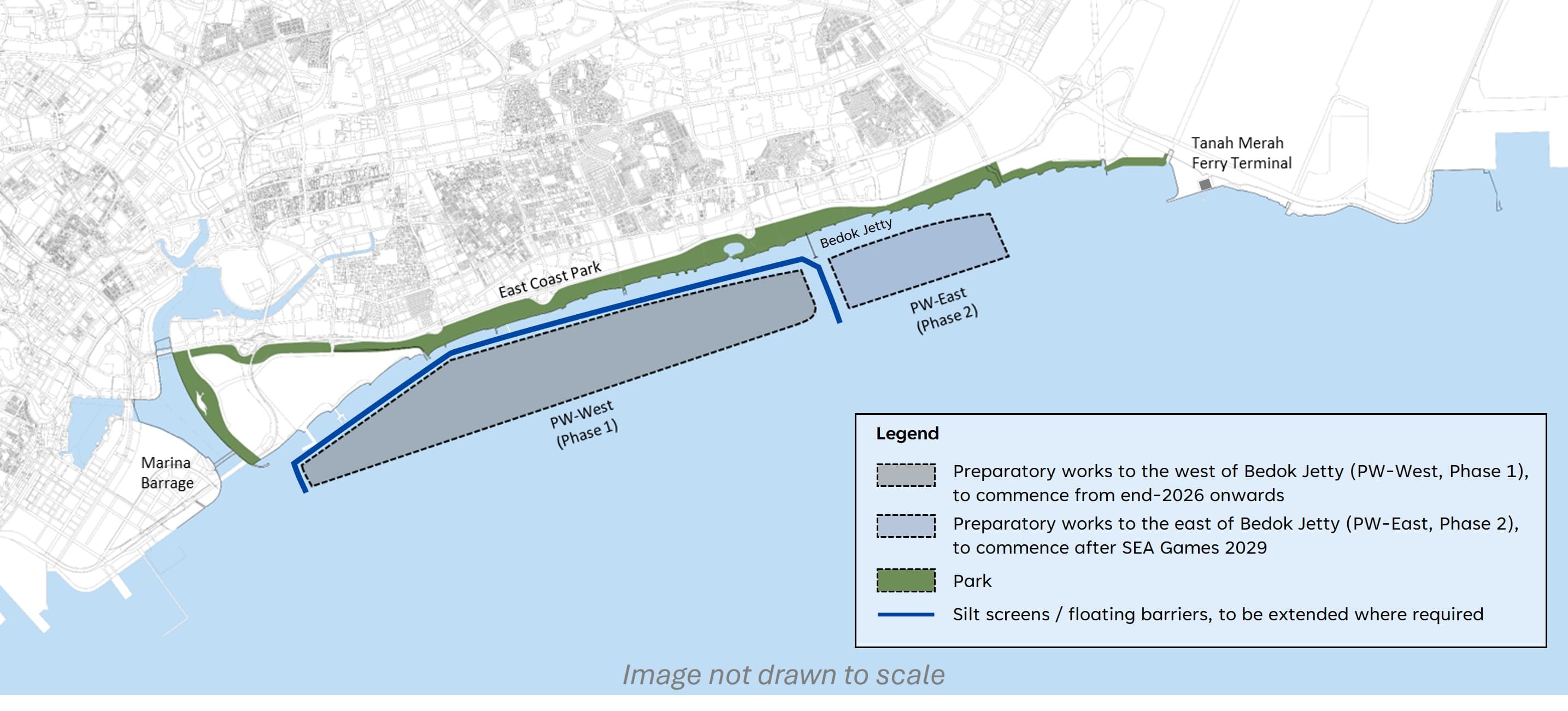
The first phase starts end-2026 in the waters west of Bedok Jetty: about 570 ha, running roughly 7km east-to-west and up to 1km out from shore. A second phase of about 155 ha follows to the east of Bedok Jetty, but it only begins after the East Coast hosts its major events, including the 2029 SEA Games, so the sea space stays open until then. For now the work is narrow: removing seabed obstructions, then building temporary sand bunds and infilling with sand, all kept at least 130m off the shoreline and marked off by silt screens and floating barriers.
What changes for residents right now
URA's environmental study is reassuring on the day-to-day. Water quality stays within marine standards. Swimming continues along the whole East Coast, and East Coast Park stays open. The disruptions are contained: some sea-sports users get displaced, kiteboarders most of all, with alternative sites offered east of Bedok Jetty and elsewhere. There'll be intermittent dust and sediment plumes near the works, held in by silt screens and monitored. Coral and seagrass near the site may see short-term, localised impact, but the bulk of it, including Sisters' Islands Marine Park, is largely unaffected.